Cats: on Christmas cards, but not in the Bible

Each year a special Christmas animal
Whose turn is it this year?

Every year there’s a noticeable particular animal trend in Christmas card pictures.   One year it was penguins, and they were everywhere. It’s been horses (often attached to stagecoaches),

decorated mediaeval hedghog
another festive Christmas hedgehog….nothing new under the sun

occasionally stags, or even hedgehogs in recent years.  Sheep and donkeys often get a look in, but at least they are there in the Gospel narrative. Cutesy polar bears were around last year (nothing to do with the Nativity, and quite a strain. A less cutesy animal is hard to imagine, possibly only the giant squid).  Sometimes the animals are natural(istic), sometimes completely anthropomorphised (e.g. robins with waistcoats).  This year, one Hampshire council has opted for a sixteen-foot neon marmot as its main Christmas display, baffling at least some of its residents (and I have to say I don’t warm to the rodent-type animals, however Christmassily dressed).  I am still working from a very small sample, but I think this year’s animal may turn out to be a reindeer (again).  Maybe there’s a cycle, like Chinese astrological animals, though evidently a different selection (I’ve never seen a Christmas ox, or heard of a Chinese Year of the hedgehog).

lots of animals at once, all celebrating Christmas together as they do
Cats and Christmas

Cats nearly always feature among the Christmas cards, even if they aren’t the main animal that year.   A cosy scene with a fire, a chair, holly round the hearth and a cat curled up on a cushion : this seems to be an irresistible Christmas trope.  Cats represent comfort and cosiness, practically a personification of hygge.  You don’t even have to have a cat to understand the message here, and celebrating warmth and comfort in the middle of a dark winter antedates the Christian era.  So there are lots of cats on Christmas cards; but (except for much later, especially twentieth-century versions) they are not present in the Bethlehem scene.  (Someone actually said that about the marmot, and one can only agree.  They aren’t native to Britain …. or Palestine.)

Nearly everything else, but no cats!
Cats are uncanonical

When I wrote a blog on animals in the psalms, I was slightly surprised to find there were no cats in the psalms at all.  I was even more surprised, on extending my research, to find there were no cats in the Bible (this is making me feel like Edna Mode and ‘no capes’ in The Incredibles).  There are obvious reasons for this.  For a long time the Israelites were in Egypt as slaves.  They preserved their difference and resisted integration by defining themselves against the Egyptians, in various ways.  The Egyptians had a very striking cat-god; the Jews avoided cats, and did not have them in their houses.

The great Egyptian cat at the British Museum,
The animals which are in the Bible

There are big cats in the Bible : mountain lions and proper lions, among the wild beasts and dwellers on the mountains.  They are creatures which the psalmist prays to be delivered from.  But he doesn’t mention domestic animals much.  There are the ones which represent your wealth (sheep, cattle, goats), and there are the wild ones which are a threat to them (lions, wolves, packs of dogs).  There are the (mostly) harmless and beautiful ones whose function is to demonstrate God’s beauty and power (everything else, including birds, fish monsters and hyraxes), but the fireside cat does not feature.

Adam with assorted beasts
Here are the animals waiting to be named, including mediaeval (but not Biblical) cats, bottom left
Putting the feline back into festive

Cat lovers are not to be thwarted, though.  There are lots of books for children which tell the story of the Nativity from the point of view of the stable cat.  There are books about adopting a kitten for Christmas, Christmas carols for cats and even a cat version of The Night Before Christmas.  Here is a link to such things if you don’t believe me, and that is only one of many.  That one actually says, disarmingly, ‘It is truly amazing how many great Cat Christmas books are available for the holidays’.  Indeed it is.
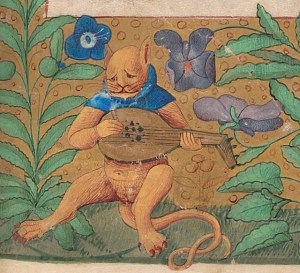
a musical cat preparing to join in with the carols
Cats who walk by themselves

These are all fairly gentle and domesticated cats, though, and I have to say that I find the ‘otherness’ of cats is the main part of their charm.  I like the way they leave you alone and have a certain aloofness, more like the Egyptian statues than the ones that look like a version of a teddy (I can feel myself shedding readers as I pursue this!).

Holy Family plus John the Baptist and his cat (Barocci)
A special cat in a special poem

I was lucky enough to read Christopher Smart’s lines on his cat Jeoffry when I was quite little.  I didn’t understand them very well, but I was charmed, and the lines stuck in my mind.   (I came across them in a wonderfully imaginative anthology of children’s verse edited by Louis Untermeyer.)   Smart was a strange man who lived in the eighteenth century and spent a lot of time in an institution for the insane (I’m not calling it a ‘mental hospital’ at this date, as I suspect it was horrific), wrote various books and died eventually in a debtors’ prison.  The lines on Jeoffry are from Jubilate Agno  (Rejoice in the Lamb), which he wrote while in the madhouse, though it wasn’t published until 1939.  Benjamin Britten set some of it to music (here’s a link).

the Minister’s cat is a musical cat
Jubilate Agno, not quite like anything else

It’s a weird work, almost like a compendium.  There are whole sections where each line starts with ‘Let’, and others where the first word is ‘For’, there are alphabetical sections, there are parts which are funny and other parts where it’s unbearably poignant.  Each line is a single sentence, which lends the whole work a sort of declamatory character, despite its being so personal.   Smart is a polymath.  He knows a  lot, but the charm is in how he puts it together.  He is a most precise observer of the natural world, with plenty of time to observe it, and he sees references to God in everything.   He is fascinated by language and music; he loves to make lists; he creates odd correspondences; he is a synaesthetic.   He is completely original and uncompromising.  Some of the time you can’t work out what he is talking about, but you feel that there is a key if only you could find it.

Jeoffry, a religious cat

Jeoffry is out of one of the ‘For’ sections, and the advantage of coming to this strange poem via Jeoffry is that it is such an acute and exact portrayal of a real, beloved cat.  And of course he is a religious cat; the second line of this section is ‘For he is the servant of the living God, duly and daily serving him’.  Smart describes him so vividly that you can see him ‘wreathing his body seven times round with elegant quickness’.  It’s really difficult to quote from Smart because a lot of the effect is in the accumulation, and I would want to go on for too long, so I recommend looking it up (full text here), and I will just mention a couple more lines : ‘For in his morning orisons he loves the sun and the sun loves him. /For he is of the tribe of Tiger.’  Indeed he is, and William Blake would recognise him.
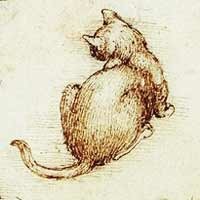
Leonardo could do cats as well
Putting cats back into the Bible

Smart thought that there should be cats in the Bible.  Indeed, he tells us that they are there, brought out of Egypt where they were numerous and plentiful (sorry, Smart’s style is catching!) : ‘For the Lord commanded Moses concerning the cats at the departure of the Children of Israel from Egypt. /For every family had one cat at least in the bag.’   You will search for this in the book of Exodus totally in vain; it’s not Moses, it’s Smart.  Smart feels that every home should have a cat because of its services in dealing with pests, but also ‘For every house is incompleat without him and a blessing is lacking in the spirit’, which is exactly what my eldest son would say of his cat today.

Cats packed for travelling
Pest control

The practical point of cats is that they deter rats and mice, though Smart mentions this almost in passing, because he enjoys so many other aspects of Jeoffry.  He does say though that the cat ‘made a great figure in Egypt for his signal services. /For he killed the Icneumon-rat very pernicious by land’, and in the mighty granaries of Egypt the cats must have been very useful.  What did the Israelites do without cats, to protect their stores?

Dealing very efficiently with the Icneumon-rat

Apparently you can also use ferrets or weasels as pest-control, so one suggestion is that the Israelites had ‘house weasels’.  I think these are, however, unlikely ever to figure as Christmas animals. Ferrets and weasels are always baddies (witness The Wind in the Willows), and fairly rat- and mouse-like themselves.   Their size, their type of fur, and their faces are against them.  (I cannot resist making another reference to the marmot.)

Felix feliciter

Christmas cats are here to stay.  They mean comfort and luxuriating in it, which is what we all enjoy at Christmas (after singing our hearts out earlier, of course).  We can only aspire to their total relaxation and satisfaction. I shall leave the last word to Smart and Jeoffry : ‘For he purrs in thankfulness, when God tells him he’s a good cat.’

Gainsborough cats

© Kate Keefe and Music for Mass 2019. Unauthorized use and/or duplication of this material without express and written permission from this site’s author and/or owner is strictly prohibited. Excerpts and links may be used, provided that full and clear credit is given to Kate Keefe and Music for Mass, with appropriate and specific direction to the original content.

What is the purpose of a church choir?

Speaking as a choir member…

I’ve been a member of at least one choir, off and on, ever since I was at school, and the first ‘outside school’ choir I joined was a church one. I love singing in a choir. I have joined the church choir in most of the places we have lived for any length of time. I even met my husband in a church choir (and that’s where he learned to play the guitar).  I am not being nasty about church choirs.

One day I’ll get him to move on to a theorbo…

This summer on our travels we got to see more different churches than usual for Sunday Masses, and I found myself thinking about church choirs and what they are actually for.  My first ever blog was about why we have music at all in church, but now I’m thinking about how we do it.

Differences between choir and church choir

I would distinguish very carefully between a church choir and a choir. Choirs learn to sing something exactly and beautifully, by doing a lot of practice. They sing different sorts of music, and often outside any context except that of a concert.  Their reason for existence is to perform the music.  Church choirs on the other hand lead the people at an event (usually a religious celebration) so that those people can take part confidently in the event itself.  The church choir may sing during a time when the congregation is doing something else (e.g. handling the collection, lining up for Communion), but it is not there to replace the effort of the congregation but to enable and enhance it. Mass is not a concert, and music should never be an excuse to stop people joining in.  I was delighted to discover that the Pope made the same point last year.

too much discipline here for a real congregation
What a choir can do

Deciding to concentrate on a choir instead of getting the people to sing is an easy trap for church musicians to fall into, because most musicians, even the non-professionals, are thinking all the time about how they can make the performance better, to do a better job at bringing the music to life, making it flower.  Using a choir instead of the congregation is a short cut.

a rare picture of a mixed choir

It’s quite difficult to find early pictures of choirs singing, because there are really only a few stock options, and in some ways it’s a relatively modern idea.  One version is the group of monks singing in community, and this is still the only model of church music which pleases some people.   Another is the single singer, often with instrument: the minstrel or the troubadour model originally, like the singer-songwriter of today.  We’ve all come across people like this singing at Mass, and it doesn’t work as a community effort.

Don’t leave it to the professionals

When we’re talking about Sunday Mass, we’re not talking about a congregation made up entirely of musicians.  Obviously any church on a Sunday is going to contain people who don’t know the music, who can’t sing in tune, who just want it to be over, who don’t feel like joining in, who can’t sing because the last time they sang that hymn was at a funeral, and the loss is still raw (and that’s even before you look at the congregation as well as the clergy).

Children can (will?) be restless and babies noisy (one old priest I knew always called that the ‘chorus of angels’).  People will take breaths in the middle of words;  they will sing passing notes that aren’t there in the text;  they know a different version of the tune (or the words – I often sing the wrong words in an older hymn because the text has been subtly altered and I’m singing from memory).  Often they don’t have a very big repertoire of hymns, so if you want to extend it, you will need to do it gently and encourage them.  As soon as they feel uncomfortable, they will simply stop singing.   They are frightened of getting something wrong and other people noticing, with a fear totally out of proportion to the likelihood of that happening.

So the music produced by a congregation is less polished and accomplished, but it’s their music, and they’re not doing it for any other audience than God.  I suspect at Mass on Sundays he’d rather hear them than a choir singing alone,  – just as you’d be disappointed if you went to your child’s school play and they had outsourced the singing to professionals.

…even if they came with a great set of instruments
Sing a new song

Having discussed the possible drawbacks of congregational singing, it’s only fair to say that it’s great to hear how well a congregation can sing if you give it the chance.  This is why we stress ‘singable’ (awful word) as the point of the music on the website, and why I try to give all my church music tunes which are easy to pick up.  Good unison is much more likely than bad harmony to allow people to feel secure enough to join in.  If your congregation consists of the same people singing the same words every day, you can decide to sing in Latin or anything else, but for most Anglophone people at church on a Sunday, it needs to be English.  If your congregation is, remarkably, exactly the same people turning up every week and they know the words, you can get them to sing chant; but for most congregations, chant will put them off, and they will leave the singing to the choir (and if you want to do chant well, weekly rehearsals are not usually enough).  Tunes were invented after chant, for a reason : they are easier for non-monks to pick up and join in.

New every Sunday?

I’m very aware that the psalm and response change every week, so accessibility is extremely important.  I’ve talked before about what makes a good psalm response.  I do ask quite a lot of my cantors, but the shape of the tune should be strong enough to help you to get back on the rails before the end of the stanza if the irregular words have thrown you off.  Then the congregation’s part is simpler, but still strong.   Only very rarely do I change the last line of a stanza, because the congregation really needs to recognise the lead-in (and of course, the cantor’s looking up, and if necessary waving at them, will also help).  Psalms do get repeated in the Lectionary (especially around Christmas and Easter), and this helps too, if it’s recent enough for the congregation to remember.  The Alleluia verse changes from week to week, but the Alleluia itself not so often (and they are modular, so you can decide just to keep to one, though I think it’s good to wake the congregation up and make them refocus every now and again).

Growing accustomed to the tune…

The Mass parts have much more chance to bed in to people’s memories, so it is worth spending time on getting them right, maybe even running through one of them before Mass if you have the chance.  It is an advantage that the congregation mostly knows the words for the Mass parts;  and/or having a tune is a great help to settling the words in your head if they have been changed.  Deciding to sing the Latin (or Greek, for the Kyrie) version every week to avoid getting to grips with the (new) English version is actually selling your congregation short, as they will end up stumbling over the English words (even while speaking) for a long time when they visit other churches.  Singing the Our Father in Latin at the standard parish Sunday Mass means that small children can’t join in with the one prayer they may know by heart, and it really annoys some young adults too (one of them being my youngest daughter).  There is a case for not singing the Our Father at all (Jesus didn’t, so far as we know).  I’ve set it so that you can sing it if you want to, but I’d always keep an eye on how many people are actually joining in, because surely that’s the most important thing.

The other version of the church choir

The other obvious version of a group of singers in this context is the angels, who turn up either alone as messengers or in a group as a choir.   Traditionally, there are nine choirs of angels, though I have no information on whether they pool their auditions, and I have heroically refrained from discussing the way in which the Church has used church choirs throughout its history as a way to prevent women singing.  But I take great comfort from the fact that the main choirs in the Bible are angels, since they do not have gender, so women can sing with the angels as much as they like.  The angels are like the best sort of church choir : they strengthen the congregation and make it brave to join in.

And here is a lovely picture of these wonderful inclusive angels with possibly the first version of a singalong sheet.  Why are they holding up the music?  Because, at any Mass, what matters is that everyone can take part.

Sing all ye citizens; all you need is the words and a full heart

[Read this in Spanish]

© Kate Keefe and Music for Mass 2019. Unauthorized use and/or duplication of this material without express and written permission from this site’s author and/or owner is strictly prohibited. Excerpts and links may be used, provided that full and clear credit is given to Kate Keefe and Music for Mass, with appropriate and specific direction to the original content.