Cats: on Christmas cards, but not in the Bible

Each year a special Christmas animal
Whose turn is it this year?

Every year there’s a noticeable particular animal trend in Christmas card pictures.   One year it was penguins, and they were everywhere. It’s been horses (often attached to stagecoaches),

decorated mediaeval hedghog
another festive Christmas hedgehog….nothing new under the sun

occasionally stags, or even hedgehogs in recent years.  Sheep and donkeys often get a look in, but at least they are there in the Gospel narrative. Cutesy polar bears were around last year (nothing to do with the Nativity, and quite a strain. A less cutesy animal is hard to imagine, possibly only the giant squid).  Sometimes the animals are natural(istic), sometimes completely anthropomorphised (e.g. robins with waistcoats).  This year, one Hampshire council has opted for a sixteen-foot neon marmot as its main Christmas display, baffling at least some of its residents (and I have to say I don’t warm to the rodent-type animals, however Christmassily dressed).  I am still working from a very small sample, but I think this year’s animal may turn out to be a reindeer (again).  Maybe there’s a cycle, like Chinese astrological animals, though evidently a different selection (I’ve never seen a Christmas ox, or heard of a Chinese Year of the hedgehog).

lots of animals at once, all celebrating Christmas together as they do
Cats and Christmas

Cats nearly always feature among the Christmas cards, even if they aren’t the main animal that year.   A cosy scene with a fire, a chair, holly round the hearth and a cat curled up on a cushion : this seems to be an irresistible Christmas trope.  Cats represent comfort and cosiness, practically a personification of hygge.  You don’t even have to have a cat to understand the message here, and celebrating warmth and comfort in the middle of a dark winter antedates the Christian era.  So there are lots of cats on Christmas cards; but (except for much later, especially twentieth-century versions) they are not present in the Bethlehem scene.  (Someone actually said that about the marmot, and one can only agree.  They aren’t native to Britain …. or Palestine.)

Nearly everything else, but no cats!
Cats are uncanonical

When I wrote a blog on animals in the psalms, I was slightly surprised to find there were no cats in the psalms at all.  I was even more surprised, on extending my research, to find there were no cats in the Bible (this is making me feel like Edna Mode and ‘no capes’ in The Incredibles).  There are obvious reasons for this.  For a long time the Israelites were in Egypt as slaves.  They preserved their difference and resisted integration by defining themselves against the Egyptians, in various ways.  The Egyptians had a very striking cat-god; the Jews avoided cats, and did not have them in their houses.

The great Egyptian cat at the British Museum,
The animals which are in the Bible

There are big cats in the Bible : mountain lions and proper lions, among the wild beasts and dwellers on the mountains.  They are creatures which the psalmist prays to be delivered from.  But he doesn’t mention domestic animals much.  There are the ones which represent your wealth (sheep, cattle, goats), and there are the wild ones which are a threat to them (lions, wolves, packs of dogs).  There are the (mostly) harmless and beautiful ones whose function is to demonstrate God’s beauty and power (everything else, including birds, fish monsters and hyraxes), but the fireside cat does not feature.

Adam with assorted beasts
Here are the animals waiting to be named, including mediaeval (but not Biblical) cats, bottom left
Putting the feline back into festive

Cat lovers are not to be thwarted, though.  There are lots of books for children which tell the story of the Nativity from the point of view of the stable cat.  There are books about adopting a kitten for Christmas, Christmas carols for cats and even a cat version of The Night Before Christmas.  Here is a link to such things if you don’t believe me, and that is only one of many.  That one actually says, disarmingly, ‘It is truly amazing how many great Cat Christmas books are available for the holidays’.  Indeed it is.
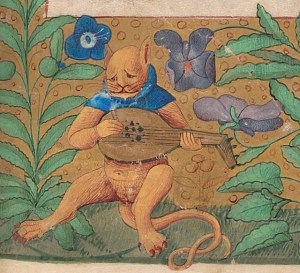
a musical cat preparing to join in with the carols
Cats who walk by themselves

These are all fairly gentle and domesticated cats, though, and I have to say that I find the ‘otherness’ of cats is the main part of their charm.  I like the way they leave you alone and have a certain aloofness, more like the Egyptian statues than the ones that look like a version of a teddy (I can feel myself shedding readers as I pursue this!).

Holy Family plus John the Baptist and his cat (Barocci)
A special cat in a special poem

I was lucky enough to read Christopher Smart’s lines on his cat Jeoffry when I was quite little.  I didn’t understand them very well, but I was charmed, and the lines stuck in my mind.   (I came across them in a wonderfully imaginative anthology of children’s verse edited by Louis Untermeyer.)   Smart was a strange man who lived in the eighteenth century and spent a lot of time in an institution for the insane (I’m not calling it a ‘mental hospital’ at this date, as I suspect it was horrific), wrote various books and died eventually in a debtors’ prison.  The lines on Jeoffry are from Jubilate Agno  (Rejoice in the Lamb), which he wrote while in the madhouse, though it wasn’t published until 1939.  Benjamin Britten set some of it to music (here’s a link).

the Minister’s cat is a musical cat
Jubilate Agno, not quite like anything else

It’s a weird work, almost like a compendium.  There are whole sections where each line starts with ‘Let’, and others where the first word is ‘For’, there are alphabetical sections, there are parts which are funny and other parts where it’s unbearably poignant.  Each line is a single sentence, which lends the whole work a sort of declamatory character, despite its being so personal.   Smart is a polymath.  He knows a  lot, but the charm is in how he puts it together.  He is a most precise observer of the natural world, with plenty of time to observe it, and he sees references to God in everything.   He is fascinated by language and music; he loves to make lists; he creates odd correspondences; he is a synaesthetic.   He is completely original and uncompromising.  Some of the time you can’t work out what he is talking about, but you feel that there is a key if only you could find it.

Jeoffry, a religious cat

Jeoffry is out of one of the ‘For’ sections, and the advantage of coming to this strange poem via Jeoffry is that it is such an acute and exact portrayal of a real, beloved cat.  And of course he is a religious cat; the second line of this section is ‘For he is the servant of the living God, duly and daily serving him’.  Smart describes him so vividly that you can see him ‘wreathing his body seven times round with elegant quickness’.  It’s really difficult to quote from Smart because a lot of the effect is in the accumulation, and I would want to go on for too long, so I recommend looking it up (full text here), and I will just mention a couple more lines : ‘For in his morning orisons he loves the sun and the sun loves him. /For he is of the tribe of Tiger.’  Indeed he is, and William Blake would recognise him.
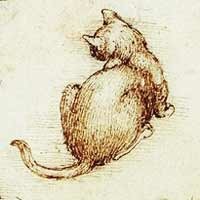
Leonardo could do cats as well
Putting cats back into the Bible

Smart thought that there should be cats in the Bible.  Indeed, he tells us that they are there, brought out of Egypt where they were numerous and plentiful (sorry, Smart’s style is catching!) : ‘For the Lord commanded Moses concerning the cats at the departure of the Children of Israel from Egypt. /For every family had one cat at least in the bag.’   You will search for this in the book of Exodus totally in vain; it’s not Moses, it’s Smart.  Smart feels that every home should have a cat because of its services in dealing with pests, but also ‘For every house is incompleat without him and a blessing is lacking in the spirit’, which is exactly what my eldest son would say of his cat today.

Cats packed for travelling
Pest control

The practical point of cats is that they deter rats and mice, though Smart mentions this almost in passing, because he enjoys so many other aspects of Jeoffry.  He does say though that the cat ‘made a great figure in Egypt for his signal services. /For he killed the Icneumon-rat very pernicious by land’, and in the mighty granaries of Egypt the cats must have been very useful.  What did the Israelites do without cats, to protect their stores?

Dealing very efficiently with the Icneumon-rat

Apparently you can also use ferrets or weasels as pest-control, so one suggestion is that the Israelites had ‘house weasels’.  I think these are, however, unlikely ever to figure as Christmas animals. Ferrets and weasels are always baddies (witness The Wind in the Willows), and fairly rat- and mouse-like themselves.   Their size, their type of fur, and their faces are against them.  (I cannot resist making another reference to the marmot.)

Felix feliciter

Christmas cats are here to stay.  They mean comfort and luxuriating in it, which is what we all enjoy at Christmas (after singing our hearts out earlier, of course).  We can only aspire to their total relaxation and satisfaction. I shall leave the last word to Smart and Jeoffry : ‘For he purrs in thankfulness, when God tells him he’s a good cat.’

Gainsborough cats

© Kate Keefe and Music for Mass 2019. Unauthorized use and/or duplication of this material without express and written permission from this site’s author and/or owner is strictly prohibited. Excerpts and links may be used, provided that full and clear credit is given to Kate Keefe and Music for Mass, with appropriate and specific direction to the original content.

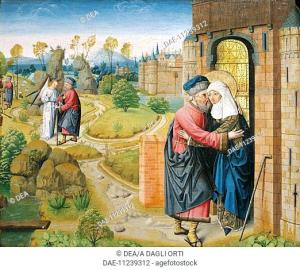
Immaculate Conception and misconceptions

The Immaculate Conception of which baby?

The Feast of the Immaculate Conception is the last Mary feast of the year, or the first one of the Church’s year, if you think of Advent as the start of it, which of course we do.   These celebrations of stages in Mary’s life parcel the year out between them, trying to show the natural rhythm of conception and birth, but they can also lead to misunderstandings,  because the feasts have difficult names and some people get genuinely confused about what’s happening, and to whom, and when.  The Immaculate Conception is not the Virgin Birth.  The first is of Mary, the second is of Jesus.

Creating the liturgy

And the Church has to find readings for them all in a text which manages to leave the Mother of God totally offstage most of the time (and doesn’t feature many other women either in a starring role, though of course we know that there must have been lots of them around all the time, holding up half the sky).  There are some great female forerunners in the Old Testament, but we don’t use their stories, which is a pity, as Mary would have known them well.

Mary feasts and Jesus feasts

With apologies to those for whom this is obvious, you can divide the Mary feasts into those about Jesus and those about Mary.

Annunciation : the angel comes to tell Mary about Jesus

The Annunciation is the feast of the conception of Jesus, with  Christmas exactly nine months later as the feast of the birth of Jesus.  The Immaculate Conception is the feast of the conception of Mary (followed exactly nine months later by Our Lady’s birthday).  The Assumption is the feast of the death of Mary (neat Churchly chiasmus there).  All the other feasts happen in between, depending (for Mary) on her various titles (Mary the Mother of God, Our Lady of Guadalupe, of Fatima etc) or (for Jesus) on various events as they unfold (the Presentation in the Temple, the Transfiguration, the Passion, the Resurrection).

The Immaculate Conception
Immaculate Conception : angel comes to tell Joachim about Mary

So we are about to celebrate the Immaculate Conception at the beginning of December : this is the conception of Mary herself, the only person since Adam and Eve to have been born without Original Sin, so that she could be a suitable mother for Jesus.  I’m not going to discuss the theology of this, for various reasons;  I’m just looking at the readings set for the feast.  This is conceptually (sorry) the first Mary feast, because it has to predate eveything else, and it does come early in the Church’s year.  It’s just unfortunate that it happens near the end of the calendar year and Christmas itself, which probably adds to the confusion.

Readings for the Mass

I can’t help thinking that some of the unclarity over the Immaculate Conception is caused by the choice of the Annunciation as the Gospel for the day.  Yes, of course it’s the pivotal moment when Mary says yes to God’s plan of redemption, but we are supposed to be celebrating her own conception (by a chaste kiss between Joachim and Anna, according to some of the Church fathers) and the fact that it’s totally different from everyone else’s, although she’s supposed to represent the human race working together with God.

Joachim and Anna cuddling the toddler Mary (Chora)
Only a small group to choose from

But there’s actually not much choice if you are looking for Mary readings.  There is no reference to the Immaculate Conception in the gospels.  Appearances of Mary are limited to the Annunciation, the Visitation (with Magnificat), the Nativity, the Presentation in the Temple, looking for Jesus after he’s been left behind in Jerusalem, the wedding at Cana, the offstage scene where Jesus gets a message that his mother and brothers are outside (and he stays where he is), the Crucifixion, and Pentecost (she is present, although there is no further reference to her).  That’s it.  And most of the time, she is present but silent; she speaks only four times, according to the record in the Gospels.  Our one lengthy piece of Mary-speech is kept as a reading for the Feast of the Assumption, though we are allowed to use it every day in Evening Prayer.  It is turned into a Responsorial psalm for the third Sunday of Advent in Year B.  I’ve talked about the Magnificat before, as a piece of (rare) female speech in the Bible.  I wish we used it more on Sundays.

First Reading : the Fall, Eve’s fault
Adam and Eve with serpent
Legs still there (for now)

So choosing the readings for the Immaculate Conception was always going to be difficult.  We start with the reading where God calls to Adam who has just eaten the apple and is hiding.  If you look this up, ‘the man and his wife’ hear God in the garden and ‘they’ hide, so Eve is definitely there.   But God calls to the man, asks Adam whether he has been eating the forbidden fruit and Adam says ‘It was the woman you put with me; she gave me the fruit and I ate it.’  Then God asks the woman, and she says ,’The serpent tempted me and I ate.’  God curses the serpent and prophesies enmity between the woman and the serpent and their descendants.   The reading ends abruptly with a short sentence explaining that the man then names the woman ‘Eve’ (derived from the Hebrew word ‘to live’) because she was the mother of all the living.  That last sentence comes a good five verses later in the chapter, and comes after God’s further words to the erring couple, which are left out.  How do we respond to this with the psalm?

Responsorial Psalm 97/98 yet again

We go back to our trusty psalm 97/98, which we have been singing repeatedly recently, and which we will sing again on Christmas Day, in exactly the same version as here, but with an extra four lines.  We positively celebrate the events of the first reading because God has brought salvation even out of such disaster (this is the felix culpa mentioned in the Easter Exsultet : ‘O happy fault which won for us so great a Redeemer’).  It’s a great joyful psalm, which encourages everyone to sing (always a good move), enumerates God’s mercies and ends by encouraging everyone to sing all over again.

After the psalm, the second reading (Ephesians 1) is a beautiful poem which again emphasizes God’s ‘pretermined plan’ which he had organised from the beginning, but as it’s St Paul, it’s all very male-oriented language, and despite the references to being chosen ‘from the beginning’, it doesn’t really seem to refer to Our Lady much.

Back on course with the Alleluia

You realise that we have strayed from the path when the Alleluia verse, the first line of the Hail Mary, almost comes as a surprise.  And some of the force of it is lost when the identical verse is translated differently in the Gospel (‘Rejoice, so highly favoured!’).  If you want echoes to reinforce the message of the readings, surely it would help if they sounded the same note.  The Gospel, as I said,  is the account of the Annunciation, exactly the same reading as set for the Annunciation feast itself.  This does contribute to the confusion, but it’s hard to think of a better Gospel reading except the Visitation (because then we’d get the Magnificat), and that would not actually cause any less confusion, because yet another baby (John the Baptist) would be in the picture.

two women, two special babies; but who is the Immaculate Conception?
Alternatives to the Gospel?

Luckily for me, both the bits I have to set to music are ones I feel happy with.  We have different versions of this psalm at various stages in the year, and it’s always a pleasure to set because it is so joyful.  The psalm and the Alleluia are celebrations of God’s plan and Our Lady’s part in it.  I can think of alternatives for the two readings, but for the Gospel I think it has to be the Annunciation because Christmas is coming round the corner,  Mary’s other sublime moment when she is the agent of God.  We can’t use the Nativity readings;  everything in Advent is building towards the event of Christmas night.  The focus is on the point of shifting from who Mary has been till now (Immaculate Conception, tribe of David, betrothed of Joseph, cousin of Elizabeth), to what she is about to do.  She is about to become the mother of God-with-us, who will be born only because she said yes when God asked the question.  The saying yes and following through are what make Mary the Queen of Heaven.  We are thanking God for her on this feast.

crib scene in illuminated capital
Sing choirs of angels….and everyone else too