Bookends : the first and the last psalms

The shape of the Book of Psalms

The Psalter or Book of Psalms in its present form has been around for a long time. We don’t know who wrote it, or when. We know it is the work of several hands, across many years, even many centuries. We know that it has been carefully and lovingly put together, as the original hymnbook for a faith older than our own.  We can draw all sorts of conclusions about why the contents of this hymnbook have been arranged in the way they have;  we can make our own, different, arrangement, according to our own need or desire.  Conclusions which we draw from the shape and ordering of the Psalter are based simply on the form in which we have it;  those who wrote the psalms were not the people who organised the collection or its ordering.

David singing
he might be thinking about the order

Bookend psalms

Having said that, though, it is fascinating to try to take an overview of the Book of Psalms, more than enough work for a lifetime. I have recently been thinking just about the bookends of the Psalter, because Psalm 1 has come up several times lately as a weekday psalm, and now so has Psalm 150.
Psalm 1 is reasonably familiar, because, among other things, it’s the psalm prescribed for St David’s Day. It is also the psalm for the Sixth Ordinary Sunday in Year C.  Psalm 150 in contrast was a new one for me to set (it is prescribed for the Wednesday of Week 33 of Year II, so November 18th this year).

Hymn books and extra pages

There are different ways to appreciate the arrangement of the bulk of the psalms: many authorities divide them up into five groups, but classifications can differ.  There is even dispute about how many psalms there are.  A few extra psalms were found among the Dead Sea Scrolls; there are other psalm-like poems in various parts of the Old Testament; many Christians would include the Magnificat and the Nunc dimittis as part of the same grouping, and even within the canonical Book of the Psalms there are repeats (Pss 14 and 53, as well as partial repeats elsewhere).  But this is what happens with hymn books and music folders.  I like to pick up old hymn books when I see them in charity shops, and they nearly always have extra pages stuffed between the cover and the book, or between the pages.  Some careful church musicians even attach extra pages or different versions of the same hymn;  sometimes things are written out by hand.  There are little notes to mark favourites, performance notes for dividing up the verses between men and women, or Dec and Can.  I like the fact that you can almost see this same behaviour going on in the choir loft since King David and even earlier.

adding your own favourites
The first and the last

But I think it is fair to look at Pss 1 and 150 and draw some conclusions, because the Book of Psalms in its current form has been the bedrock of church music and poetry for so long, and it was clearly deliberately done, and it has been accepted as valid by so many.

page of psalm in multiple languages
lovely multilingual Psalter
Psalm 1

The psalms in question are particularly attractive as bookend psalms because they contrast so neatly.  Psalm 1 is the introduction to the Psalms as a whole.  It starts positively, with a portrayal of the happy (or blessed) person (‘man’ everywhere I looked, except for the New Jerusalem, which offers ‘one’). S/he is happy or blessed because of conscious virtue and finding delight in the law of the Lord.  So we instantly have the relationship with (a slightly impersonal and distant) God and his teachings as the basis for human happiness.  There is a beautiful extended comparison to a mature tree, and then the second half of the psalm is a description of ‘the wicked’, to point the contrast.  They are like ‘winnowed chaff’, another nature simile, but probably not as instantly recognisable as the tree.  Winnowed chaff is the fluffy detritus left after the grain has been taken from the stalks it grows on; it’s good for nothing and disperses in the wind (or you can sweep it up and burn it, but you’d need a mask to keep it out of your lungs unless you did it outside, where the wind is your ally).  The last lines reiterate the contrast : the Lord guards the way of the just, but the way of the wicked leads to doom. 

Different possible Responses

An ominous ending, which we sadly lose the force of when we sing it as a Responsorial Psalm, because the Response tends to be upbeat.  Usually it’s some variant on the first line (Happy/Blessed are they who follow the law of the Lord), but it’s been coming up recently as a weekday psalm with some unfortunate variations on the Response, including Those who are victorious I will feed from the tree of life  and the egregious Behave like God as his very dear children, which I ranted about before.  But they do all tend towards the positive, because you’re asking the congregation to sing it several times, and it’s the thought they will be left with at the end.  So, though it’s tempting, when I set it, I didn’t really feel that I could imbue the word ‘doom’ with too much grue.

Psalm 1 : me and God’s word

This first psalm, then,  is about an individual, and his relationship not so much with God as with God’s rules for a holy, healthy and happy life.  It’s short enough for us to sing the whole thing (occasionally one or two lines are trimmed, but as it stands it’s three stanzas of six lines each).  It’s black and white, and robust in its language, but doesn’t need to be played down, because the psalmist has nothing to do with desiring the fate of the wicked, he’s just describing natural consequences. The music for this one is simple and like a folk song, because I wrote it for St David’s Day, with even a quotation from The Ash Grove to emphasize its Welsh roots, with St David being the patron saint of Wales.

Psalm 150 : isn’t God amazing ?!

Psalm 150 is even shorter, again three stanzas, but this time only four lines each, with an Alleluia at the beginning and end.  But the atmosphere of this psalm is totally different.  It’s joyous, chaotic, it tumbles over itself, and it’s all about praising God.  The Law is not mentioned, the psalmist is not mentioned.  It’s all a command to praise God.  Ten of the twelve lines start with the word ‘Praise’ in the imperative.  God is not asked to come down or intervene in any way.  He is ‘in his holy place’, ‘in his mighty heavens’, and we are not praising him for rescuing us, as so often in the Psalms, we are praising him because of what he does (‘his powerful deeds’) and what he is (‘his surpassing greatness’).   But there is nothing impersonal or dry about this God.  The call to praise is coming from someone personally convinced of the wonder and glory of God, so convinced that he is calling on others to come and join in.

God creating heaven and earth
What god is great as our God?
The power of music to praise God

Then the psalmist lists all the instruments used in the Temple and piles them up.  One commentator says that the different instruments symbolise those who use them, the trumpet (or horn) for the High Priest, the lute and harp for the Levites (but I would say, the musicians), the timbrel and dance traditionally for the women, the strings and pipes for the men, and it’s unclear who is playing the two different sets of cymbals, but maybe one group could be foreigners or visitors.  The psalm ends with an invitation to ‘everything that lives and that breathes’ to join in.
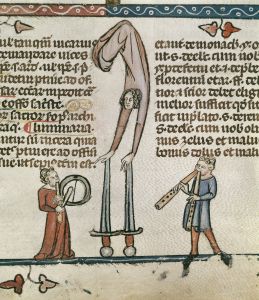
Musicians and tumbler
Church musicians encouraging everyone to join in

It’s really exciting and fun, and I was surprised to find that I hadn’t set it before, which means that it’s not prescribed for any Sunday or major feast in the three year Lectionary. I can only guess that this is because of its position in the Book of Psalms, and the way it feels like a culmination of the whole sequence in a triumphant final shout of praise.  We sing Ps 147 repeatedly, but the last three psalms only rarely.  They are all litanies of praise, with Ps 150 the most exuberant, hence its position.

Setting the last of the psalms
Musician king with courtiers
Let’s all join in with David’s psalms

How do you set words like these? Ideally you have the instruments to play each their own part, but of course most of us don’t, so all I can do is attempt to suggest them (if, on the other hand, you are lucky enough to have a little drum or cymbal, I’ve left rests where you can add them to the mix).  The tune needs to be simple rather than sophisticated, using the repetition that is so strong a feature of the words, and above all easy to pick up and join in confidently.  The cantor has to deal with a dancing rhythm, but the Response is straightforward and strong.  It’s also the first line of the Sanctus, so it’s familiar, and maybe it will help people get over trying to pause after the third ‘Holy’, even though the comma is no longer there (this can’t be only my parish, surely?).   We have lost the Alleluia at the beginning and the end, but as the First Reading reminds us, this Response is what the angels sing in God’s presence, so we can put our hearts into it and ‘swell the mighty flood’, as the old hymn says.  When we sing the psalms, we are not just singing with all the angels, either; we are singing with all the millions of people through history who have appreciated the wonderful resource that is the Book of Psalms.  It is a great privilege to be able to sing these words and put them to music for others to do so.  What a wonderful throng to have around you.

Church choir
everybody wideawake and joining in the singing

© Kate Keefe and Music for Mass 2020 Unauthorized use and/or duplication of this material without express and written permission from this site’s author and/or owner is strictly prohibited. Excerpts and links may be used, provided that full and clear credit is given to Kate Keefe and Music for Mass with appropriate and specific direction to the original content.

Another good old hymn : Holy God we praise thy name

The matter of words

I like hymns with good words. A hymn ought to be able to be prayed without its music, which is very handy at the moment when we aren’t allowed to sing in many of our churches. A lot of modern hymns are disappointing in this aspect, not able to sustain the weight of prayerful attention and lacking in solid theology, but older hymns are a wonderful resource which it is a shame to neglect.

a hymn book without the music is a prayer book
Words and/or music

The best hymns, of course, are those memorable for both words and tune, but a set of really good words or a really good tune can keep a hymn going on its own. Here is a hymn with good words and an excellent tune, from the Germans who gave us so many of our best tunes (and a couple of beloved composers as well).  Holy God, we praise thy name (with more or fewer capital letters) was a staple in all the hymn books we used at school and growing up.  In later life, I discovered it was a favourite with many American friends, who had even chosen to sing it at their weddings.  I hadn’t gone that far, but I loved the fine rolling tune and the way the words followed the roll so exactly, especially in the second verse.

A version of the Te Deum

As so often, the story is more complicated than at first appears.  The words are an adaptation of the Te Deum laudamus, one of the oldest Church hymns, so old that we don’t even know who was responsible for it.  Both St Ambrose and St Augustine have been suggested, but the hymn is thought to be even older than those names would indicate.  As a text, I find it a little unwieldy, in both Latin and English.  It feels like a set of sentences laid out on the page with minimal organisation.  It is a hymn of sorts, but it’s written in prose.  The last part is a collection of what we would nowadays call ‘arrow prayers’, taken from the psalms.  The Te Deum divides antiphonally with ease. This probably led to the myth of Saints Augustine and Ambrose creating it spontaneously together, like a two-man rap, but its rhythms are not patterned until it comes out of the Latin , and the standard English version in the Book of Common Prayer keeps stopping and starting.  It has been a part of the liturgy for centuries, and is one of the prayers which is really useful ecumenically : most Anglicans are more familiar with it than Catholics, as it plays a central role in Matins.

The translator (into German)

The version we have in our (older) hymnbooks has three or usually four verses, but the Te Deum is quite a bit longer than this.  Our version comes via a German paraphrase of the Latin, in twelve verses, by Ignaz Franz (a Catholic priest), in 1771.  He does a fine job, metrical without being forced, and even elegant in places.  He edited it later down to eleven and then eight verses and it occurs in several different hymnals in several different versions.  It was a Catholic hymn originally, and then was adopted by the Protestants.  It became frequent in Protestant hymnals only in the twentieth century, according to wikipedia, but the tune is slightly different (it goes up instead of down at the end of lines 1 and 3, which makes a surprising amount of difference).

Protestant hymnal 1901, with the variant in the tune
Classic Mitteleuropean

It then went through a bad patch, acquiring an extra verse in praise of Hitler, and being adopted as a military machismo hymn, which is unfair if you read the lyrics.  The Poles have a version; the Swiss have an extra pacifist verse;  and I’m certain that I have sung it in Czech.  This happens with a lot of the good German hymns : their words fit the tune so well that they can often be translated into related languages with minimal adjustment, and the tunes export with no problems at all.  The tune we sing was actually written for the (German) words; you can tell because it’s named from the first words of the verse, like a Bach chorale.

Moving into English

The German words are solid and straightforward.  The English ones are not always quite so felicitous, but when the number of verses was reduced, we lost most of the awkward lines.  I regret the loss of two parts in particular, though it was probably a wise decision.   First this one, because it sounds completely Gilbert and Sullivan, the tune emphasizing ‘tri-bu-tary’ just like ‘tutelary’ in The Mikado  (and it just means ‘subject’):

Thou art King of glory, Christ:
Son of God, yet born of Mary;
For us sinners sacrificed,
And to death a tributary:
First to break the bars of death,
Thou hast opened Heaven to faith.

Resurrection
The Lord himself as the first of the ‘startled dead’

and then these lines:

When Thy voice shall shake the earth,
And the startled dead come forth.

because I like that ‘startled dead’ so much.  It is not in the German.

The translator into English

However, let me get back to the version that we actually sing.  The English version was translated by Clarence A. Walworth in 1858.  He was an American (note the spelling of ‘scepter’) lawyer who studied for the Episcopal ministry but then later converted to Catholicism and became a priest.  He wrote poems (which Oscar Wilde was rude about), and translated the German version  into English, which was then published in the Catholic Psalmist, Dublin 1858.  The long text is in the wiki article, but here are the verses in our modern hymnals.  Sometimes they are slightly modernised (you/your instead of Thee/Thy, which works easily because it’s an unstressed syllable). 

1. Holy God, we praise Thy Name;
Lord of all, we bow before Thee!
All on earth Thy scepter claim,
All in Heaven above adore Thee;
Infinite Thy vast domain,
Everlasting is Thy reign.

2. Hark! the loud celestial hymn
Angel choirs above are raising,
Cherubim and seraphim,
In unceasing chorus praising,
Fill the heavens with sweet accord:
Holy, holy, holy, Lord.

3. Holy Father, Holy Son,
Holy Spirit, Three we name Thee;
While in essence only One,
Undivided God we claim Thee;
And adoring bend the knee,
While we own the mystery.

4. Spare Thy people, Lord, we pray,
By a thousand snares surrounded:
Keep us without sin today,
Never let us be confounded.
Lo, I put my trust in Thee;
Never, Lord, abandon me.

Matching the words to the music

I think the power of this hymn comes partly from the complete correspondence of tune and words.  The words roll on, like the waves of the sea, measured and rhythmic, each verse apart from the first being a single sentence (spot the German influence, although there are more full stops in the German version).  The rhymes are solid and show little strain, alternating simple and composite very effectively (apart from the unconvincing ‘claim’ in the first verse, which has always niggled at me; sometimes it’s replaced by ‘own’, but that messes up the rhyme).   In the second verse, the singers accumulate as the lines roll out, culminating effortlessly in the first line of the Sanctus, and by then we too are singing with the angels, as part of the mighty chorus.  It works beautifully.

Angel choir
angel choirs enabling a singalong

On the whole the English translation is more self-conscious and affective, certainly more adjectival,  than the German.  I would almost say ‘more Counter-Reformation’, except I’m not sure how much to ascribe to that movement in the Chuch and how much Father Walworth’s version is coloured by an American rather than a European idiom.  The whole hymn would be too much, but the reduced version works well. 

The last verse as a contrast

The last section of the Te Deum, the short collection of arrow prayers or one-liners, is much reduced in the translations.  Even in the German, it is limited to a single verse, and Walworth does the same.  I particularly like the way that the orotund majesty which informs the first three verses contrasts with the simplicity of the petitions in the last verse.  The English version is more acute and emphatic, mainly because it changes from the plural to the singular in the last two lines.  The German, like the Latin, uses the plural throughout,  but the sudden change here in the English version to the specific and individual is arresting.

Job surrounded by fierce animals
I need help here
Changing the focus from ‘we’ to ‘I’

The psalms that use the plural throughout tend to be the more ceremonial ones, the Songs of Ascents, the Temple celebrations, the laments.   The psalmist is singing to God; about various things, about his life, about what’s going on.  He’s not singing to other people, but sometimes he sings about the group to which he belongs.  By the rivers of Babylon/ there we sat and wept (Ps 136/137).  In the same way, the Te Deum is almost like the Creed or the Gloria.  It is a set of statements of belief, and the people are plural.   The singular on the other hand tends to be for the more intimate psalms, the penitentials, the yearning psalms.  The Lord is my shepherd (Ps 22/23).   Any dialogue is between God and the individual, never two human beings, one reason why the psalms belong to anyone who reads them.

David and tongue
just the psalmist and God in this conversation
From risk to reassurance

Often the narrative in a psalm is of the individual set against an undifferentiated crowd of enemies, and that is what is evoked here in the last verse of the hymn.  The first four lines are a simple statement of being beleaguered, or ‘tempested, travailed and afflicted’, as Julian of Norwich puts it.  But then the last two lines move from the political to the personal, with a cry for help : Lo, I put my trust in Thee,/ Never, Lord, abandon me.  This sudden shift to the first person singular, in the last two lines and falling on the last, heavy note of the whole hymn, is very striking, and paradoxically comforting, because we can all instantly identify with it.

Beautiful tents
my enemies encamped around about me
The power of the personal

It reminds me specifically of Psalm 118/119, the longest psalm in the Psalter, which I have written about before, a long, mainly tranquil, even rather smug treatise-poem on the beauties of the Law and how much the psalmist loves it.  It’s an alphabetical psalm, and it just keeps on moving on letter by letter, explaining to God how virtuous and remarkable the speaker is,  until the last stanza, where suddenly the psalmist, this great and eminent jurist, this expert in the Law as given, blurts out ‘I am lost like a sheep; seek your servant/for I remember your commands’ , and the psalm ends abruptly.  Just as in the psalm we move from the majesty of the Law to the rescue of one individual, so we move in the hymn from the enormous majesty of God in mighty chords of music (and you really do need an organ for this hymn) to the singer’s own complete dependence upon him.  In contrast to the tune, the words here are broken and almost breathless, with those two commas : this is entirely down to the English translation, as the German words here are sonorous and smooth.  Breathless but not desperate, because the singer here is as confident as the one in Psalm 62/63 : ‘My soul clings to you;/your right hand holds me fast’ (v.9).  Very personal; very close; very comforting.

© Kate Keefe and Music for Mass 2020 Unauthorized use and/or duplication of this material without express and written permission from this site’s author and/or owner is strictly prohibited. Excerpts and links may be used, provided that full and clear credit is given to Kate Keefe and Music for Mass with appropriate and specific direction to the original content.